
At a minimum, higher ed has a duty to make a degree and the educational experience that supports it valuable to students. Colleges and universities do that through teaching, mentoring, community, career outcomes, and the transformation that happens in a student’s life. A question, though, that’s rarely asked is whether your institution captures that value through price in a way that serves its goals.
That’s the question IMD professor Stefan Michel posed in his 2014 Harvard Business Review article, and it remains a useful lens for higher education right now.
The Pressure Is Real, and We Saw It Coming
Higher ed is under intense pressure from every direction. The most predictable disruption is demographic. The 2008 Great Recession changed how families weigh the value of college, and families themselves changed, with fewer children and less traditional structures. The result was a shrinking pipeline of future students.
This demographic decline was noted early on, and higher education’s anticipation has been highly influenced by Carleton College labor economist Nathan Grawe. He made his enrollment projections from a small pool of student data and an understanding of how college choice had differed in the past between first- and second-generation students.
Grawe’s projections rested on a reasonable premise: that second-generation students, those whose parents had gone to college, would consider and choose colleges as previous second-generation students had done. Thus, the impact of a declining number of available students would not spread enrollment declines proportionately. The more selective colleges would suffer less.
We might now question that premise. College participation began slipping before the demographic decline did; public confidence in the value of a college degree has fallen over the past decade. And choosing not to go to college carries far less social stigma than it once did. Perhaps historical patterns no longer apply. We know that enrollment behavior from last year predicts little about next year.
Pricing is highly connected to these market attitudes and perceptions. Years of a discounting arms race, sticker-price inflation, and revenue-focused tactics have taught families the gamesmanship happening behind the scenes with tuition pricing. Students and parents have adapted, and the old assumptions about how they make buying decisions no longer hold.
And we haven’t even mentioned COVID-19 and the many self-inflicted wounds that national, state, and institutional policies caused.
The Pricing Model Everyone Criticizes, the Public Policy Regime That Sustains It, and the Critics Who Think They Discovered It
A growing number of critics argue that the higher ed pricing model, with its high sticker prices and heavy discounts, is deceptive or even unethical. There’s plenty of discussion about whether it’s sustainable and whether price should simply be reset.
Less attention goes to what keeps the regime in place: federal policy. The structure of aid, the rules institutions operate within, and the incentives those rules create shape pricing behavior far more than any single institution’s choices. A single college can’t reset its way out of a system. But it can decide how it best meets the market to serve its mission within that system.
Michel’s Framework: Five Categories for Capturing Value Differently
In his Harvard Business Review article “Capture More Value,” Michel studied cases across industries and identified 15 ways to capture value differently, grouped into five categories:
- Change the price mechanism: how the price is set
- Change the payer: who actually pays for the value
- Change the price carrier: what you attach the price tag to
- Change the timing: when you capture the value
- Change the segment: how value capture varies across groups
His examples are memorable. LifeStraw found a different payer, using carbon credits to fund water filters for people who couldn’t afford them. Nespresso moved the price carrier from a kilogram of coffee to a single capsule. Google lets advertisers set the price through auctions. In each case, the innovation wasn’t only creating something valuable. It was a creative decision about how to capture that value.
Michel also makes a point that matters for institutions: don’t delegate this to any one person or department. It takes a cross-functional team working on it regularly and systematically, not just when margin is under pressure. He recommends using the framework for offense (finding new ideas) and defense (spotting competitors that capture value differently and could attack from an unexpected side).
What This Means for Higher Ed
Michel’s framework is about capturing more value. For colleges and universities, the more useful question is how to capture value in alignment with an institution’s mission and strategic priorities.
Many institutions have drifted toward a narrow version of this: optimize net tuition revenue, hit the class, protect the discount rate. Those are legitimate pressures. But when optimization becomes the goal rather than a tool, price drifts away from mission, and the institution loses sight of what it’s trying to achieve.
Better questions look like this:
- How do you align the way you meet the market with what the market actually is and what your goals actually are?
- How do you align price with value, meaning the value you create for students and the value the institution needs to sustain its mission?
- Which students are you trying to enroll, and does your pricing and aid strategy move you toward them?
- Where are you competing on a price mechanism that no longer works in a post-optimized environment?
Michel’s categories offer a way to work through these. Who pays, and when? How do different segments experience your price? What is the price actually attached to? These aren’t abstract exercises. They’re the design choices embedded in every aid strategy.
Financial Aid Optimization Is No Longer Only a Function of Yield
Anna Swanson, Founding Partner and Managing Director at MARKETview, takes a view that cuts against how the term is usually used. In her perspective, financial aid “optimization” isn’t just about increasing yield. It’s about arranging your dollars in the best possible way relative to your goals.
That’s different from optimizing revenue. It starts with knowing your goals (mission, mix, access, net revenue, or some blend) and then deploying aid deliberately to serve them.
Doing that well begins up-funnel. By the time an admitted student is weighing an offer, most of the important decisions have already been made. Who you attract, who you engage, and who sees themselves at your institution all shape what aid can accomplish. Aid strategy that starts at the offer stage works with what’s left over.
“Financial aid optimization’ as traditionally understood is dead. In this environment, institutions can no longer rely only on back-end aid tweaking. MARKETview’s Aid Studio positions aid strategy where it belongs—at the front of the enrollment funnel, fully integrated with your institutional objectives and the value you deliver to students.”
— Anna Swanson, Founding Partner and Managing Director, MARKETview
Aligning Price With Purpose
Higher education will keep changing, and the pressure isn’t going away. But institutions aren’t powerless inside a system shaped by federal policy and demographic reality. They can choose how to capture the value they create, and they can do it in service of their goals rather than optimization for its own sake.
AID STUDIO
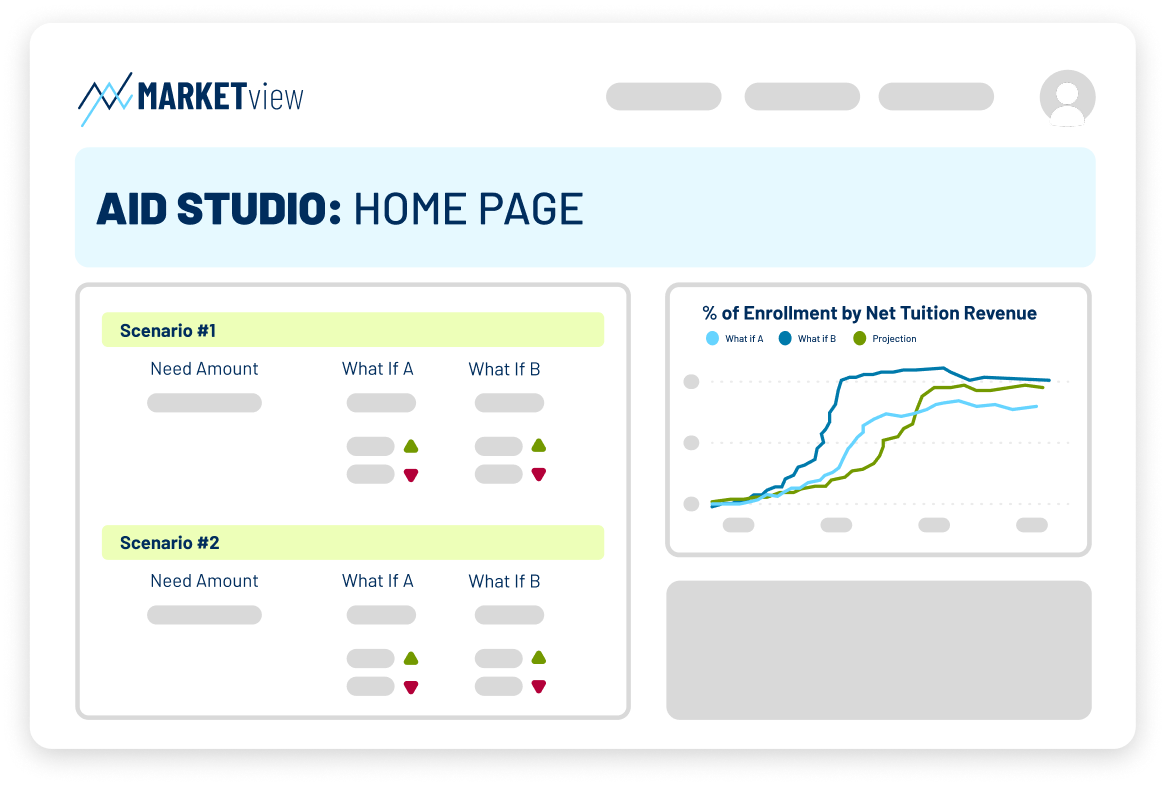
Ready to put this into practice? Aid Studio, powered by MARKETview, lets your team test aid scenarios against your goals, from headcount and yield to discount rate and net tuition revenue, before a policy is final. Combined with the market context MARKETview provides up-funnel, it helps you arrange aid dollars in the way that best serves your institution.